Concept
Atomic Habits
Atomic Habits means tiny habits: small steps that add up a little bit every day.
- 1
Set up the habit
One question per step: who do you want to be? When and where will you do it? And what is the smallest thing that still counts, say just two cards?
Set up the habit
One question per step: who do you want to be? When and where will you do it? And what is the smallest thing that still counts, say just two cards?
- 2
Get reminded, check it off
At the time you chose, the reminder arrives with your minimum and your place. One tap on “Yes, done”: every check-off is a vote for the person you want to be.
Get reminded, check it off
At the time you chose, the reminder arrives with your minimum and your place. One tap on “Yes, done”: every check-off is a vote for the person you want to be.
- 3
Keep going
The grid shows every day, the phases show the way: building, forming from 7, established from 30, anchored from 66. Skipping once does not break the streak.
Keep going
The grid shows every day, the phases show the way: building, forming from 7, established from 30, anchored from 66. Skipping once does not break the streak.
Picture a piggy bank. One cent a day goes unnoticed. After a few years, though, it jingles quite a bit. That is how tiny habits work: each day counts only a tiny bit, but together they change a lot.
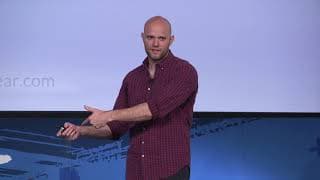
The term comes from James Clear. In high school, a baseball bat accidentally hit him in the face, and afterwards he had to fight his way back slowly, one tiny step at a time. That experience and many years of writing became his book “Atomic Habits” in 2018. It became a worldwide bestseller, even though the basic idea fits into one sentence: start small and keep at it.
Big resolutions often fail because they are too hard. Small steps feel easy, so you actually do them. How you think about yourself helps too. Someone who sees herself as a runner is more likely to go running than someone who is just supposed to run. And when the trigger is easy to see, you don't have to keep thinking about it.
In Mnemorya you can set a sentence about yourself for each habit, for example “I am someone who studies every day”. Every tick then counts as a vote for exactly that person. You can attach a new habit to one you already have, like “After breakfast, I study …”. With a list for your surroundings you make triggers visible. And you can skip on purpose without it counting as failure. The rule behind it: never miss twice in a row.
The research behind it
The studies this method rests on. Each one is verifiable through its DOI — looking them up is very much the point.
The book shows how small daily steps, a clear trigger and the picture you have of yourself work together to build lasting habits.
Atomic Habits: An Easy & Proven Way to Build Good Habits & Break Bad Ones. Avery (Penguin Random House).
People voted more often when they were asked whether they wanted to be voters instead of whether they wanted to vote: the picture you have of yourself makes a difference.
Motivating voter turnout by invoking the self. Proceedings of the National Academy of Sciences, 108(31), 12653-12656.
doi.org/10.1073/pnas.1103343108The overview shows that habits form mainly through repetition in the same surroundings and then run almost by themselves.
Psychology of Habit. Annual Review of Psychology, 67(1), 289-314.
doi.org/10.1146/annurev-psych-122414-033417
Keep watching
See the idea in motion.
Selected videos for going deeper. Each link opens the original creator on YouTube.