
Learning format
Bildpfad
One image, many points on it — you work through them in order and hang something on each that you want to remember.
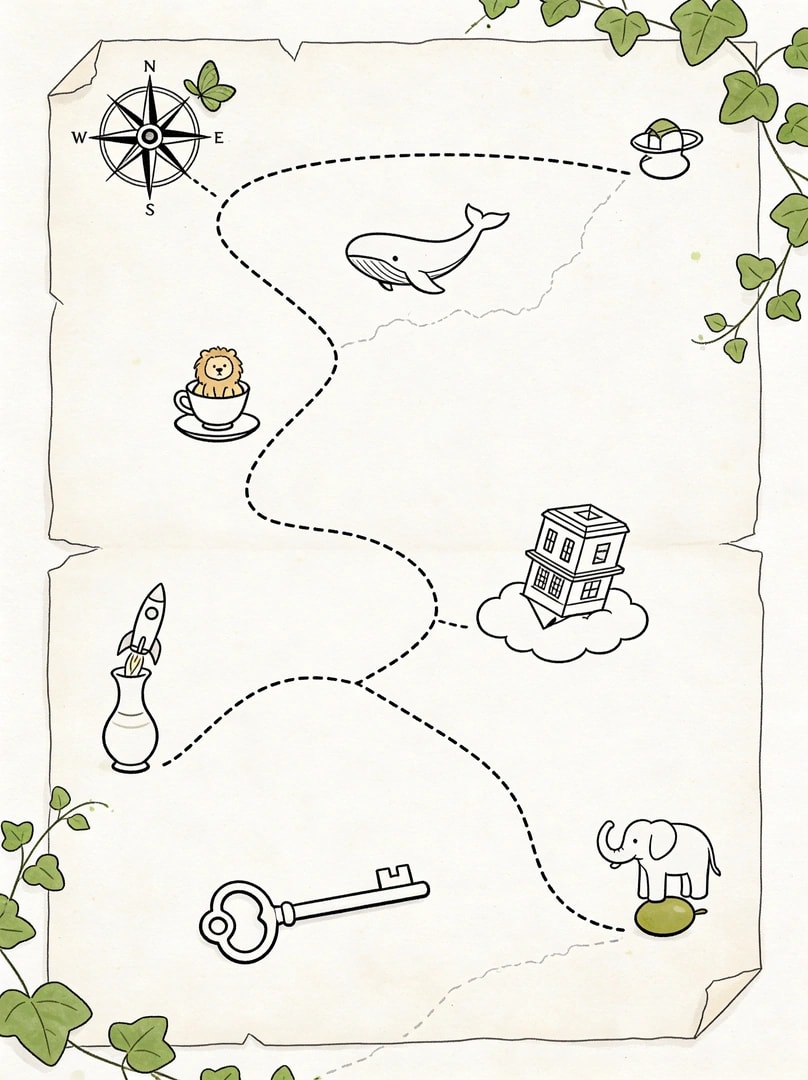
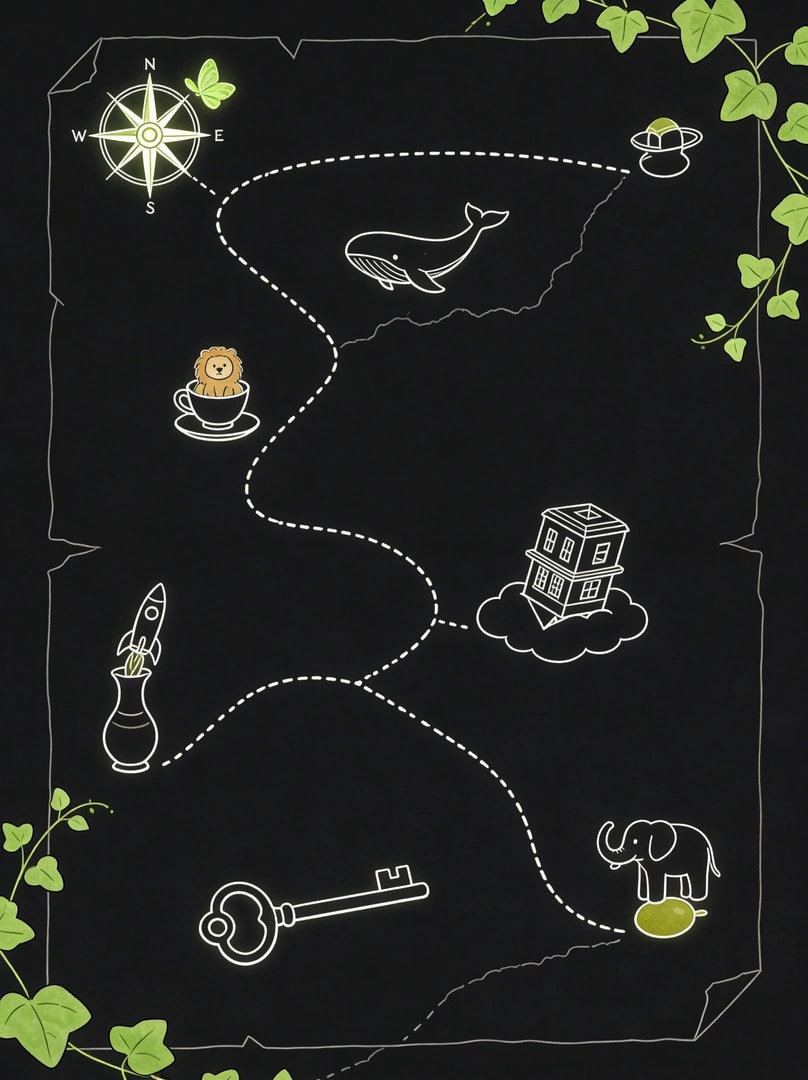
The Bildpfad is the memory palace for people who would rather not walk a route. Instead of rooms and stations you take a single image — a photo, an illustration, a diagram — and place points on it. Each point carries a piece of content, and the order of the points is the path.
Why an image helps has to do with how we store images. A word enters memory as a word; an image often enters additionally as a mental picture — two routes instead of one. That is the classic explanation and it has stood since the sixties. It is not uncontested, though: more recent work traces the advantage instead to the fact that images differ from one another more than words do. The effect is solid, the explanation for it is still being argued about.
For you that changes little, because both explanations recommend the same thing: an image whose locations are clearly distinct. A cluttered shelf works better than a white wall, a map better than a colour gradient. What you can tell apart, you can find again.
In Mnemorya you add an image of your own — photo, screenshot, drawing — and place the points by tapping. Each gets its content, and when you work through it you follow them in the order you set. What stuck and what did not feeds into when it comes back to you.
The research behind it
The studies this method rests on. Each one is verifiable through its DOI — looking them up is very much the point.
The basis of dual coding: concrete material is stored additionally as a mental image and is therefore retrievable by two routes rather than one. Still the most cited explanation for why images stick better.
Mental imagery in associative learning and memory. Psychological Review, 76(3), 241–263.
doi.org/10.1037/h0027272The counter-position, which is why it is here: the image advantage persists even where dual coding cannot account for it. The authors trace it instead to distinctiveness — images resemble one another less than words do.
Distinctiveness, not dual coding, explains the picture-superiority effect. Quarterly Journal of Experimental Psychology, 78(1), 180–191.
doi.org/10.1177/17470218241235520Why an order belongs to it: the same work that underpins the memory palace shows that spatial arrangement structures retrieval. A path across an image uses the same mechanism on a smaller scale.
Routes to remembering: the brains behind superior memory. Nature Neuroscience, 6(1), 90–95.
doi.org/10.1038/nn988
Keep watching
See the idea in motion.
Selected videos for going deeper. Each link opens the original creator on YouTube.