Concept
Feynman technique
You only really understand something when you can explain it so simply that a child can follow.
- 1
Pick Feynman
At the top of the Mnemo chat you set the mode to Feynman. Mnemo puts on his suit for it.
Pick Feynman
At the top of the Mnemo chat you set the mode to Feynman. Mnemo puts on his suit for it.
- 2
You explain
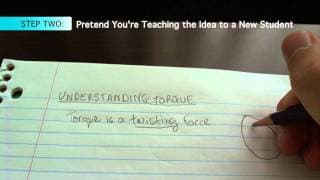
Explain a topic in your own words. Mnemo listens and digs into every technical term that explains nothing.
You explain
Explain a topic in your own words. Mnemo listens and digs into every technical term that explains nothing.
- 3
Say it simpler
You say it again, more simply, with a picture from everyday life. Mnemo tells you what now holds — and where a gap remains.
Say it simpler
You say it again, more simply, with a picture from everyday life. Mnemo tells you what now holds — and where a gap remains.
Imagine your little sister asks: why is the sky blue? As soon as you try to answer, you notice where your knowledge has holes. That is exactly the Feynman technique. You explain a topic in simple words, find the spots where you get stuck, look those up again and then explain it even more simply.
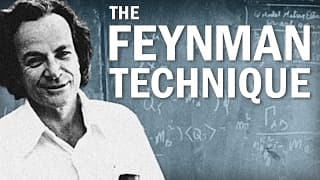
Richard Feynman was an American physicist who won the Nobel Prize in 1965. He was famous for explaining difficult things so that anyone could understand them. One day, in the cafeteria at Cornell University, he saw someone throw a plate into the air. The plate wobbled, Feynman did the math just for fun, and later he wrote that his whole Nobel Prize work came from playing around with that wobbling plate. By the way, he never used the name Feynman technique himself. Other people named the four steps later, for example the blogger Scott Young.
When you only read something, it quickly feels familiar. That is misleading. Only when you explain it do you have to put the pieces together yourself, and that makes it obvious right away what is missing. Plus, what you have put into your own words sticks much better. Experiments show: people who explain material to someone remember it longer than people who just read it again.
In Mnemorya there is Mnemo's Feynman mode for this. Here you turn the tables: you explain a topic to Mnemo, by text or with your voice. Mnemo listens, asks follow-up questions where things get unclear, and guides you step by step to an explanation that even a child understands.
The research behind it
The studies this method rests on. Each one is verifiable through its DOI — looking them up is very much the point.
Students who afterwards actually explained a text in front of a camera knew more a week later than those who only prepared to explain it.
The relative benefits of learning by teaching and teaching expectancy. Contemporary Educational Psychology, 38(4), 281–288.
doi.org/10.1016/j.cedpsych.2013.06.001Children put in more effort when they were supposed to teach the material to a computer character than when they were just learning for themselves.
Teachable Agents and the Protégé Effect: Increasing the Effort Towards Learning. Journal of Science Education and Technology, 18(4), 334–352.
doi.org/10.1007/s10956-009-9180-4In his memoirs, Feynman tells stories like the one about the wobbling plate in the cafeteria himself.
"Surely You're Joking, Mr. Feynman!": Adventures of a Curious Character. W. W. Norton.
Keep watching
See the idea in motion.
Selected videos for going deeper. Each link opens the original creator on YouTube.