Concept
Zone of proximal development
You learn the most where you can't do something on your own yet, but already can with a little help.
- 1
See the path
Chapter by chapter, each world a stage. Mnemo stands where you are right now.
See the path
Chapter by chapter, each world a stage. Mnemo stands where you are right now.
- 2
Jump into a level
A level bundles what belongs together: a video, an image path through one night, cards to quiz yourself.
Jump into a level
A level bundles what belongs together: a video, an image path through one night, cards to quiz yourself.
- 3
Move on
Done earns stars, the gate to the next chapter opens, and the new world rises out of the fog.
Move on
Done earns stars, the gate to the next chapter opens, and the new world rises out of the fog.
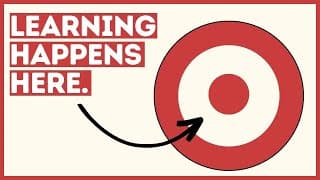
Picture three circles. Inside is everything you can already do on your own. Way outside is what you can't manage even with help. In between is a ring: things you can just about pull off with a good tip. This ring is called the zone of proximal development, “proximal” meaning “next”. Like riding a bike with someone's hand on the back of the seat: soon you'll ride on your own.
The idea comes from Lev Vygotsky, a Soviet psychologist. He lived from 1896 to 1934 and died of tuberculosis at just 37. In his short life he wrote so much that the world only really listened decades later. His most important thoughts came out in English in 1978 in the collection Mind in Society. Already in 1976, researchers around Jerome Bruner had shown how adults help small children build a pyramid out of blocks. They called this help scaffolding: you support only as much as needed and take it down bit by bit.
If a task is too easy, you get bored and learn nothing new. If it is way too hard, you give up. Right in between, your head has to stretch, but it makes it. That is when your skills grow fastest. That is why it pays to first figure out what you already know.
In Mnemorya the Atlas uses what the app already knows about your prior knowledge. When refining, you can also enter it yourself: Brand new, Some idea or Already solid, plus a free text. That way the learning path starts where you are right now, and not at zero or way too far ahead.
The research behind it
The studies this method rests on. Each one is verifiable through its DOI — looking them up is very much the point.
An adult helped children build a pyramid out of blocks and gave only as much help as needed; that is where the picture of scaffolding in learning came from.
The role of tutoring in problem solving. Journal of Child Psychology and Psychiatry, 17(2), 89–100.
doi.org/10.1111/j.1469-7610.1976.tb00381.xAn overview of ten years of research shows: good help adapts to the learner and gets less bit by bit.
Scaffolding in Teacher–Student Interaction: A Decade of Research. Educational Psychology Review, 22(3), 271–296.
doi.org/10.1007/s10648-010-9127-6This collection brings together Vygotsky's thoughts on the zone of proximal development in English for the first time.
Mind in Society: The Development of Higher Psychological Processes. Harvard University Press.
Keep watching
See the idea in motion.
Selected videos for going deeper. Each link opens the original creator on YouTube.